Jack Marsh on Taste-Bench
A future
with ornament
AI, taste, and the things
we choose to live with.
 Watch the conversation
Episode cover courtesy of Taste-Bench.
An editorial reading
of the conversation.
What shall we make
with all this possibility?
For Jack Marsh, new technology opens a question about the world we want to inhabit. His conversation with Taste-Bench begins with Delft tiles and reaches towards ornament, cultural memory and the pleasure of making a home your own.
Jack is an art historian and co-founder of Not Quite Past. Here he describes AI as a medium that can take direction from a particular tradition: its marks, irregularities, subjects and ways of seeing. The ambition is to make objects with a character worth keeping.
A tradition with room in it
In Jack’s account, the appeal of old Delft lies partly in its freedom. A quick brushstroke, an uneven outline or a slightly improbable animal can give a tile its life. A tradition continues through people working within it, taking risks and introducing new subjects. An immaculate imitation can miss that spirit.
Possibility needs judgement
Specialised models allow experiments within a chosen visual world. They still need decisions: which references matter, which result has character, which colours belong together, and when to stop. Jack returns to curation, collaboration and the value of limits. The ability to generate more makes the ability to choose more consequential.
That choice can take several forms. Some people want to invent a design; others want a collection they can trust, or a conversation with someone who understands their room. The point is to give a personal idea a convincing form.
The test is a thing in a room
A tile takes the conversation out of the screen. Someone chooses it, puts it in a home and lives alongside it. Jack measures the promise of these tools against that kind of attachment: whether the result is beautiful enough, and particular enough, to earn a lasting place.
A more particular future
The larger ambition is a richer decorative world. Jack sees a possibility for new tools to give ornament, local stories and historical continuities fresh expression. He speaks of belonging: surroundings in which people can recognise something of their place, their interests and their history.
That is a hope for what technology might help us make. Taste, context and an attentive audience remain part of the work.
The article and diagram are editorial paraphrases of Jack’s ideas. The conversation below retains the speakers and the order of the discussion.
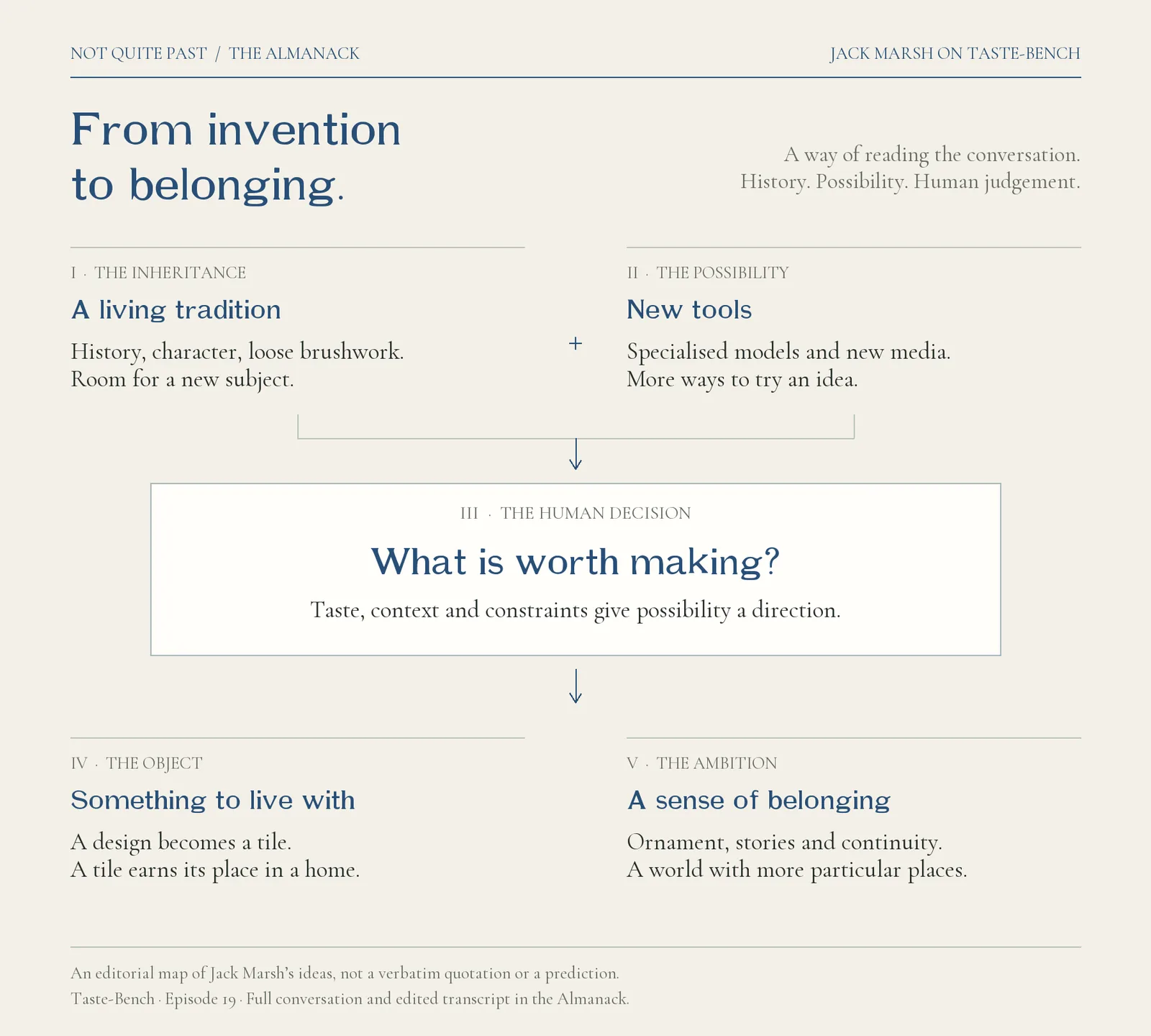
From invention
to belonging
A way of reading Jack’s argument.
Follow an idea into the transcript.
A living tradition
History, character, loose brushwork.
Room for a new subject.
New tools
Specialised models and new media.
More ways to try an idea.
What is worth making?
Taste, context and constraints give possibility a direction.
Judgement & the value of limits →Something to live with
A design becomes a tile.
A tile earns its place in a home.
A sense of belonging
Ornament, stories and continuity.
A world with more particular places.
An editorial map, not a verbatim quotation or a prediction. Save the diagram ↓
Edited from Taste-Bench’s automatic transcript for clarity and flow. Fillers, false starts and repetitive acknowledgements have been removed; substantive ideas and speaker turns are retained. This edition has not been checked against the audio. Unclear passages are marked, and historical claims remain those of the speakers.
Open the full edited conversation
This is a reading edition of the complete automatic transcript available from Taste-Bench. Repetitions, false starts and non-substantive interjections have been removed; interrupted sentences have been joined where their meaning is clear. All substantive questions, arguments, examples and replies have been retained in their original order. The opening extract is also retained, although it recurs later in the conversation. Obvious transcription errors and spellings have been corrected. A few unclear passages are marked in brackets. This edition has not been checked against the audio and should not be described as verbatim. Historical interpretations and accounts of projects remain the speakers’ statements at the time of recording, rather than independently verified facts or current product promises. Section headings are editorial.
Opening extract: a new medium
Jack Marsh
Photography was a new medium. I am a very historically minded person, but history is useful here. For a very brief period, people thought photography was the end of painting. Then they realised it wasn’t.
People say AI image generation is the end of creating. No, it isn’t. What it will do is create a new art form, and a chain reaction in every other art that affects them enormously. Photography pushed art towards more abstract, loose and painterly forms: Impressionism, various forms of Symbolism, and people like Gustave Moreau, producing incredibly mythical, strange paintings.
What is a Delft tile?
Philipp Zahn
Welcome to Taste-Bench. I’m Philipp Zahn. My co-host is Bruno Marnette, and this is a podcast about taste and the creative side of AI. Today’s guest is Jack Marsh, an art historian and co-founder of Not Quite Past. The company uses AI to produce custom tiles in the traditional Delft style. But this is just the first step: Jack and his co-founder want to use AI more broadly to change interior design.
Jack, it’s a pleasure to have you. Let’s start with a simple question: what is a Delft tile?
Jack Marsh
That has many different answers. A simple answer, in antique terms, is a tile made mainly in the Low Countries—although there is an expansion into England, because they copy it—from the middle of the sixteenth century into the nineteenth century.
Your listeners and viewers might be familiar with blue and white. That’s interesting, because Delft tiles don’t immediately start with blue and white. They begin as a form of maiolica, brought by people from, I believe, Italy, who set up shop in Antwerp around 1525. They are very bright and colourful. You might not recognise them as Delft tiles, but technically they are.
Maiolica or faience is a kind of tin-glazed ceramic. Tin gives an opaque white, which lends enormous brightness to the pigments you put on or into it. These immigrants brought their tiles to the burgeoning markets and burgesses of the Low Countries.
Blue and white came in during the very early seventeenth century, around 1615 or so. It’s an interesting story. In China there was the Wanli Emperor, who took a slightly different approach from previous Ming emperors. This was the waning of the Ming dynasty, with things going very wrong, marauders at the borders and, eventually, the Qing coming in. The Wanli Emperor opened up trade with Europe a little more.
That brought a much larger trickle of porcelain and other Chinese goods into the Netherlands and Spain. You see them in countless still lifes and Renaissance paintings. Here was blue and white in shocking colour, on extremely fine porcelain, and Europe went wild for it.
Then, after Wanli, a new emperor adopted a different policy and strangled trade. A gap appeared in the market for blue-and-white porcelain. The ingenious traders of the burgeoning Dutch Republic decided to move away from the brightly coloured ware and towards that market. The blue and white of Delft was, in that sense, a marketing move. If porcelain was no longer coming into Europe, why not paint things blue and white and give them a vaguely Chinese character?
The earliest tiles have a Chinese-style border. Some people call it the Wanli hoekmotief, or corner motif. That’s really the beginning of the iconic blue-and-white tiles. But they have a wonderful development over time. I’m slightly obsessive, so you’ve opened a—
Bruno Marnette
Floodgate.
Philipp Zahn
That’s a good thing. Please do go on.
Jack Marsh
What’s interesting about Delft tiles is that they start off heavily framed, with a pattern going across several tiles, almost like a rug. The pattern might dominate across four tiles, so the repeat is four tiles rather than one.
As the sixteenth century moves into the seventeenth, you have the rise of Dutch art, the observation of everyday life and the love of interiors. You go from Bosch, with his demonic fear of everyday life, to Bruegel, and then to people like Vermeer and Pieter de Hooch: this love of observation.
The tiles begin heavily patterned and framed, sometimes with diamond-shaped frames. Then the frame starts to disappear. It gets less and less, until it is reduced to little corner motifs. The corner motifs are like the memory of a frame. The frame has been destroyed, and what remains is this great white space: an enormous theatrical space into which the entire world, people’s fantasies and their imaginations can come.
The Delft tile becomes a white space for the observation of everyday life. You see everything on them: people carrying sacks, Cupids, people frolicking and almost engaging in sexual acts, political controversies. Just as Dutch Golden Age painting depicts everyday life, so do the tiles. You find tiles in Vermeer and Pieter de Hooch paintings because they are depicting interiors. And in the tiles themselves you can find the Dutch mind and world.
There is a wonderful development, and then it tapers off. In the eighteenth century the Netherlands falls behind as Britain and other countries industrialise. That brings me to something I really want to talk about: slop is not a new phenomenon.
Philipp Zahn
Tile slop.
Jack Marsh
The industrialisation of beauty in the eighteenth and nineteenth centuries is crucial to understanding AI, slop and beauty. I’d love to talk about William Morris and the Great Exhibition. But let me finish the story of Delft tiles first.
In eighteenth-century Liverpool, you get Sadler and Green using engravings. Instead of putting ordinary ink on an engraving to print onto a page, you put ceramic pigment on it and print onto tiles.
Previously, Delft tiles had been painted rapidly by people. They had very good industrial processes of their own. Their spareness was partly economical: if there is only a tiny Cupid or figure in the middle, you can produce thousands very quickly.
They also used something called pouncing, which is still done. In Mexico there is a faience tradition called Talavera Poblana; I’ve been to some of the great factories here, and they still do it. You take tracing paper, poke holes along the outlines of the design, then bash a little bag of charcoal dust against it. That leaves dots showing where to paint. The painters are, in a sense, filling in the gaps. There is beauty and feeling, of course, but it is an incredibly organised process.
Then people in eighteenth-century England use woodcuts and engravings to print ceramic pigment onto tiles. This leads to an explosion of ceramic wares, and the Dutch cannot compete. They sell farther afield—to Poland and Russia, for example. There are extraordinary Russian palace interiors with entire walls covered in Delft tiles. They are selling farther away because they are being outcompeted closer to home.
Eventually the tradition declines in the nineteenth century and is only slowly and partly recovered. The Arts and Crafts movement, itself a response to slop, revives it a little. William Morris engages with Delft painting. But essentially the tradition dies away.
Now Delft tiles are incredibly popular again. In certain parts of England and America they are seen as very desirable. The interior-design world loves the word “timeless”. Of course, these things are very time-bound, but they fall under that rubric. I think it means design inflected with heritage, but not so garish that it impedes a more modern taste for spareness.
Anyway, that is a long answer to a very short question.
Keeping a tradition alive
Philipp Zahn
It was a very good answer, and interesting to learn. You founded Not Quite Past, which seems to be doing several things at once. Before describing the company, could you locate it in the market? What did the market for these tiles look like before you entered it? How were they normally produced?
Jack Marsh
We are doing multiple things. Even the company as it appears on the website is only part of it, because we are expanding into different areas.
Delft tiles are quite popular, and there is a broad range of production. Some tiles are not very well informed in their design. Others are almost pure copies, but copies in an interesting way. As often happens when people revive something, they turn a living tradition—a tradition that had mistakes and room for creativity—into something too well behaved.
The tiles are overly perfect. There isn’t a loose brushstroke. They don’t take risks. So much meaning and creativity involves risk-taking. A lot of heritage tiles, even hand-painted ones, don’t reflect the life that Delft tiles were full of.
As I said, the old tiles were painted quickly and with enormous gusto. Brushstrokes went wild; things were asymmetrical or placed in odd positions. They would sell slightly smudged tiles, and those were beloved. The heritage versions can be very well behaved by comparison.
There were also existing tile-printing and transfer companies. I should say that we don’t simply print: we use a modern version of the traditional transfer process. The ceramic pigment is bound into the tile. It is not like a decoration on a mug that peels off in the dishwasher. You can put these in the dishwasher and they will be fine, because the pigment is chemically bound.
The broader background was the idea that you couldn’t use AI at all. This was 2023 and 2024, when “slop” was emerging as a term. I remember wondering where it had come from. People kept using it, and it became a meme.
There are many rivers flowing into the idea of our company, but one was this: I studied art history, and you see artists—certainly in the modern era—take something degraded, discarded or abject and try to make it beautiful. That seemed an important challenge for AI: could we make it rooted, interesting and beautiful?
Could we get AI designs into some of the most luxurious interiors? The answer is absolutely yes. Our tiles have gone into rarefied environments. We have done commissions for Eton College, for the headmaster’s office and house, and for luxury homes. They are sold in various places.
The broad assumption that nobody likes slop, AI produces slop and that’s the end of it is wrong. Used in the right way, AI can create things people won’t merely put on a wall: they will grout them into their bathrooms and look at them every day for ten or fifteen years. We get commissions from people who want things to stay for fifty or a hundred years. That isn’t ephemeral. It is enduring, not meaningless.
Philipp Zahn
It’s the opposite.
Jack Marsh
It is something people will live with, something that will accompany them for a long time. In a way it was a philosophical experiment: can it be done? Yes—but it has to be done in the right way.
We make Delft tiles; we have a factory in Stoke-on-Trent, and you can use our website to make them. We have also learned a lot from how customers approach the process. More broadly, we are looking at robotics and artificial intelligence as ways of making ornamental things, not only tiles. We are working on a number of projects.
Making, choosing and working together
Philipp Zahn
There are many things we could branch into, and we’ll come back to them. But I want to drill down into the process. Someone visiting your website has the option to create their own tiles. Can you walk us through that?
If someone puts in a motif, is there any correction or feedback from you? Perhaps “correction” is the wrong word, but is there a point at which you say, “Be careful about putting that in your kitchen or bathroom for the next fifty years”?
Jack Marsh
Philipp, we’re very ecumenical. We welcome all tastes. We’ve had some pretty saucy tiles, I can tell you.
Bruno Marnette
You couldn’t speak poorly of your users.
Jack Marsh
Broadly, there are two options. We have a shop with designs we’ve made, which you can buy. Then you can make your own.
There are different models trained on very specific kinds of tiles and motifs from particular periods, historically accurate in that sense. You can type in “dog”, “seagulls”, “a potted plant”, “a cactus”—whatever—and it will often produce a very good interpretation of that style with your motif. You can take it further and do quite crazy things. That is part of the fun.
We do very high-end things, but it is also a fun company. People forget that AI can open up the creative process to people who don’t immediately have the skills. That experience of making something is exciting.
Something surprised me, though. A lot of customers do use that route, but the majority of our orders—and certainly the big orders—come from customers talking to us. They email, tell us what they want or send a few images. Often it is an interior designer rather than the customer directly. We work with lots of interior designers, who may have a particular colour and a specific vision.
It isn’t simply a case of prompting models trained on Delft tiles. It is an ongoing collaboration. We are a design company, and I do a lot of work that is almost design consultancy. I personally make many tiles for people. That shows there is an element which cannot be automated at the moment, or at least not entirely.
People like creativity, but the experience most people want is to walk into a shop, see beautiful things and choose something. People have taste: they like what they like. But that doesn’t mean they are going to sit down for an hour and devise an entire complicated decorative scheme.
They might go to Chanel, a furniture shop or an interior designer with an idea and want someone else to create it. There is still a distinction between the customer and the craftsman, maker or creative person. The idea that AI means everybody will be making all their own things isn’t true.
It is a great experience to go into a shop, see extraordinary patterns and tiles, be told what they mean and be walked through them. That is what most people want. AI for makers and craftsmen is a separate question.
Our models are on the website, but they often act as a gateway into a conversation. People send an email, and we work with them on a set, very often with a lot of AI involved. I’m not personally drawing those tiles; the work is done with artificial intelligence. That is how it works.
Meaning lives around the object
Philipp Zahn
Can I follow up on that? What you describe leaves something in the conversation between the person buying and the person making. Even going into a shop, you are suddenly in conversation with a palette or portfolio of different things. The same seems true when someone emails you: “I have an idea, but I’m uncertain.” Is that relationship important because the conversation refines what the person wants along the way?
Jack Marsh
It is crucial. I studied art history, and if you are interested in a subject you ask yourself what its point is. What is the point of art history?
There is an idea that you don’t need knowledge to encounter an artwork: you walk into a gallery, look at a work and it immediately conveys everything you need. But meaning is contextual. Meaning is outside the object, and the more you understand about an object, the more powerful its meaning can be.
Imagine two identical Van Goghs—two versions of The Starry Night or a café at night. Then someone gives you one piece of context: this one was painted by Van Gogh, and this one is a forgery made a year ago. That changes everything. It tells you that the experience and meaning of art are not simply contained in the sovereign artwork.
Philipp Zahn
The object.
Jack Marsh
Kant, in the Critique of Judgment, says that in something like a still life with beautiful food, anything that relates to the world is bad and not art. Art should be completely disinterested: a pure play of form. That is what he creates in the Critique of Judgment. From this comes the idea that the artwork stands alone, almost better the less contextual meaning it has. The pure aesthetic experience is simply that play of form.
I don’t think that is true. I think it is indicative of the period in which he wrote, when those ideas were alluring to an enlightened audience. Art is context.
So, to return to your question: the more you engage with something and understand its history, the more you want to elaborate a decorative scheme, the more meaningful it becomes. That is very clear.
A playful tool, a serious object
Bruno Marnette
I’m curious about those different uses: at one end, people visit your website with an idea and design something themselves; at the other, you have the Eton headmaster. A common challenge in starting a business is deciding on a brand. The advice is often to start small and expand later, but you seem to have started widely.
What challenges or dilemmas have you encountered? How can you be perceived as a trusted, top-tier partner for interior designers and also as a playful website where people make something as quickly as they might print a T-shirt? Is there tension between those two brands or businesses?
Jack Marsh
Of course. We hold those things together quite strongly in an evolving marketing position.
We got a lot of press. The idea of using AI to make beautiful things was powerful in 2024. Some of it was deliberate, and some was a surprise, but it was explosive. We received media attention almost immediately: the Financial Times, a full-page article in The Spectator, the Spectator podcast and many other things. People were curious about the idea, and that launched us strongly.
If you identify something meaningful—and I think Delft tiles are iconic and meaningful to an English public, certainly in some more elite circles—it can catch on. Interior designers took a chance on us, and we built from there.
Much of this business is word of mouth. Someone knows someone who knows someone. The website is a showroom; a great deal of the main work happens by email. Once you give good service and become known in that quite interconnected interior-design world, people start coming to you.
We appeal to both audiences, but we certainly aspire to the higher end. We don’t want slop or things that feel wrong, tawdry or soulless. There is also an element of play, and the business does different things and will do more.
One small point about why we chose tiles: the outputs of generative AI in 2023 and early 2024 were very small. We had ideas for wallpaper—and have made wallpaper—and other things. But tiles were perfect because they are small and square. You could put that output directly onto an object.
Most importantly, it was an object. That was part of what made it compelling.
Philipp Zahn
It stands for itself.
Jack Marsh
It was a physical object you could get quickly—something you had created, delivered in four weeks. We chose tiles partly because their size made the resolution of the outputs at that time workable: not blurry slop, but something of quite high quality.
Slop before AI: industry and ornament
Philipp Zahn
You’ve already touched on changing production processes and economics: those affect distribution, what consumers can afford and, perhaps later, taste. Could you walk us through that mechanism in tiles, and how you see it from your perspective as an entrepreneur?
Jack Marsh
The economic ramifications of AI, or something more specific?
Philipp Zahn
You mentioned that there was a kind of “slopification” in the nineteenth century. What consequences followed, and what parallels do you see with AI slop now?
Jack Marsh
That’s a huge topic. Let’s start with the Great Exhibition of 1851. Are you familiar with the Crystal Palace, built by Joseph Paxton?
Philipp Zahn
No, I’m not.
Jack Marsh
I would call it probably the most significant building made by a British person in the nineteenth century. It was an enormous temporary building. Paxton had built great greenhouses for wealthy clients—aristocrats who wanted specimen plants in a warm environment—and applied that approach to an exhibition building.
You should get a picture up. It is a gigantic glass-and-steel structure.
Philipp Zahn
Wow. It looks massive.
Jack Marsh
I call it so important because it foreshadows the glass-and-steel construction that becomes important in Chicago, the birthplace of the skyscraper, and then modernism. Many new buildings in cities around the world are glass and steel. Paxton is part of the beginning of that story.
It had something like 300,000 panes of glass and was built extraordinarily quickly. You know how long things can take today. It also had beautiful neo-Gothic ornament. The building was a triumph of Victorian ingenuity, engineering and decoration.
But the exhibition was, in some ways, seen as a catastrophe. Industrialisation had made mass production possible, including mass-produced ornament. In the preceding eighty or ninety years in Britain, you increasingly found crazy forms of rather tatty ornament on everything. Some made little sense; some looked wrong or fell apart. Slop—slop 1.0.
Philipp Zahn
Yes.
Jack Marsh
In a way, it is where we are now. Ornament had required craftsmanship, materials, hours of work and years of training. It signified high quality. Industrial production detached it from those conditions. Many people could make ornament, sometimes without much cultivation or understanding, and there was a huge proliferation of it.
The Crystal Palace was meant to celebrate what Britain could produce, although many other nations were invited too. You could see Persian rugs and Chinese objects, among other things. Yet many people felt the English section was poor.
Wallpapers might be judged by how many colours they contained rather than the quality of the design. There were rugs with three-dimensional scenes and poorly handled perspective, with figures floating around. People asked why you would do that on a rug. A rug needs a pattern; these designs seemed not to understand the object.
Then you went to the Persian section and saw beautiful, flat designs and fine craftsmanship. People thought this was a crisis: we have enormous industrial power, but what we make is ugly compared with things from India, Persia or China.
In 1852, at Marlborough House, they put on what was called a Chamber of Horrors: an exhibition of bad examples. A slop exhibition, in effect.
An interesting earlier figure is Wedgwood. He took industrial ceramic production, including transferware, and made it tasteful. He sold to kings, queens and elites. He was a brilliant marketer, but also understood that this tool of industrial creation could make beautiful things.
That is an example of taking a new process—AI now, or industrial processes in the eighteenth and nineteenth centuries—and bringing it into a practice of taste. You build context and meaning, root things in traditions, understand what they are meant to be and what works visually. Wedgwood shows that mass production can occupy the heights of elite taste.
In the nineteenth century you also have the Arts and Crafts response: figures such as William Morris and Ruskin arguing for a return to craft. That’s a simplification, but broadly the point. Ruskin cares about the conditions of a work. Machine work is dead; something made by a craftsman, with the errors of life, is alive.
Then there is modernism, which perhaps still defines our era most strongly. There are many ways to understand its functionalism and bare walls, but one is as a reaction to the nineteenth century’s extraordinary quantity of ornament and explosion of styles: historicism, neo-Baroque, neo-Gothic, neo-Moorish, neoclassicism. Walk around Vienna and you see that variety.
Modernism says, in effect, that this atmosphere is infected by nineteenth-century madness: we will do away with ornament, have bare walls, be functional and create a machine aesthetic. You can interpret it as a response to slop—to the excess of mass-produced ornament, pattern books and selectable styles.
What I mean is that the nineteenth century plays out the problem of slop in an interesting way. I’m glad to have had the chance to explain it at length.
Can a machine recognise taste?
Bruno Marnette
You’ve laid out several criteria for recognising that slop: it wasn’t rooted in meaning or tradition, and it didn’t make sense. Could we build a slop detector today—something that looked at a ChatGPT-generated image and quickly decided that it didn’t make sense? What would be difficult about that?
Jack Marsh
If we mean images that don’t make sense, I think AI can address that. More intelligence and computation should produce multimodal models that understand something better before creating it.
But there are different kinds of slop. There is incoherence, and then there is garishness, poor quality, something vulgar or something that simply doesn’t feel right. LLM prose can have a sloppy style, with stock constructions and phrases [one example is unclear in the automatic transcript].
Bruno Marnette
Cliché.
Jack Marsh
Exactly. Those things can certainly improve. The deeper question concerns taste, and beneath that, questions of meaning and beauty.
“Taste” is an interesting word. It can feel like a bourgeois subject: we are individuals and each of us has tastes. But there is also culture, which belongs to groups, not only individuals. Perhaps an obsession with taste reflects our liberal, individualist and globalised age. We may be less comfortable with representations of group identity or history; perhaps AI companies are, too.
Yet you see people from different cultures using AI to express identities of their own. I may have lost my thread a little.
Bruno Marnette
We were asking whether a machine can distinguish slop from something better. You’ve covered much of it, while leaving room for the difficult-to-explain notion of taste. Is that fair?
Jack Marsh
Yes. I think it could improve greatly. But one key problem is that AI is a universal tool, whereas taste is inherently about difference and differentiation. Taste involves discrimination: one thing is better than another. I choose one wine over another or one artwork over another. I spend a lot on an artwork because I find it beautiful and feel it expresses me.
How do you make a generalist AI sufficiently differentiated? Taste is also social. We act in groups, compare ourselves with one another and understand people through those comparisons. Bourdieu writes about social capital. I don’t necessarily accept all of his thinking, but he is clear that taste can operate as hierarchy or a kind of game. It can also express a society’s transcendent values around art and beauty.
That is harder to model because it is dynamic. Taste and fashion are constantly changing; beauty and meaning are deeper questions, but all these things interact. Something is proposed as beautiful, becomes fashionable, becomes ubiquitous, and then becomes boring because everyone has it. It isn’t even a simple cycle; it keeps changing.
Philipp Zahn
Evolution.
Jack Marsh
Will AI predict fashion? I don’t know. Might it identify the important people in fashion, monitor their work and accurately distil the styles and decisions they make in response to others? That seems more possible. Whether it can make the taste decision itself is still difficult.
That returns us to contextual meaning. As soon as you say something is made by AI, its value diminishes for some people. Meaning comes from the forces around an object, including the thought that someone has devoted a life to it.
Part of the power of Van Gogh’s paintings is the story of his life: working for years by himself, famously selling one painting, writing passionate letters. There are his struggles: he ends up in an asylum, cuts off his ear and kills himself. Why is a last painting particularly interesting? Context.
AI struggles with context. Perhaps we need to bring process into it. I’m interested in process, mistakes, risk and sacrifice.
Philipp Zahn
There’s the famous Robert Capa photograph from the Spanish Civil War. Imagine it were AI-generated: it would almost be meaningless. Knowing the backstory changes it. It might have been staged, but he was there, and we know other things about him. Or take Vermeer, who wasn’t widely recognised for a long time. The process and backstory change our perspective on the paintings and photographs.
Jack Marsh
Absolutely. A photograph that doesn’t connect to something is almost a nonsense—although that can be interesting in its own way. I see AI as an amplifying tool.
Powerful tools need a visual education
Jack Marsh
I see AI rather as Wedgwood saw transfer printing in ceramics. After the Great Exhibition, people began using industrial processes to create beautiful things.
Take the V&A in London. Its original institution was the Museum of Manufactures, founded in the 1850s with Henry Cole. The point was to look at great crafts and arts throughout history and say: we have new tools and machines; we need to learn how to make things as beautiful as these.
It is, in that sense, a museum against slop. It asks how we can use powerful tools to make beautiful things, root them in tradition and understand what makes something beautiful. We have an extraordinary tool, but how should we use it?
You are working at a more general level: can AI understand taste and differentiation? I have worked on a tiny, embodied project—Delft tiles. But we are doing similar things, asking how these tools can help people make beautiful things or make better creative decisions. I think it is entirely possible.
A new medium, and a physical world
Philipp Zahn
These tools often introduce a new grammar. Photography, or oil painting, offers new opportunities. There is an explosion of experiments, then consolidation or recognition that some things work better than others.
How do you see that happening? You’re not only focused on tiles; you want to move further into interior design and perhaps beyond. How do you want to experiment, and how might you evaluate the results?
Jack Marsh
Your point is that AI has its own possibilities: it is a new medium, as photography was a new medium. Again, I’m very historically minded, but history is useful here.
For a very brief period, people thought photography meant the end of painting. Then they realised it didn’t. People say AI image generation is the end of creating. No, it isn’t. It will create a new art form and set off a chain reaction across every other art.
Photography pushed painting towards more abstract, loose and painterly forms: Impressionism, Symbolism, Gustave Moreau’s mythical, strange paintings, and painters such as Whistler working in very abstract ways. Art moved away from verisimilitude—the idea that it should simply imitate appearances—as its defining criterion.
At the same time, painters looked at photography itself. Photography is strange: you can move a camera and produce a blur. Those blurred images can be powerful. Late nineteenth-century compositions move away from a hierarchical, triangular arrangement; things seem to float as though seen through a camera. Some images are deliberately blurred.
AI will transform art, how meaning is made and the craft of making art. But it will not destroy it.
There is so much we could do in interiors. AI is one wing of the biplane; robotics is the other. Robotics is physical intelligence, if you like, while AI is mental intelligence.
People are using robotic arms to carve sculpture. There is someone at Monumental Labs [the person’s name is unclear in the automatic transcript] doing that. Even there, they use a final process of hand-working, perhaps five per cent, because the cleanness of the robotic result can feel too much.
We are developing an AI that won’t simply produce an image through the usual diffusion process, but will understand how to make it brushstroke by brushstroke. I’m interested in process, mistakes and chance. AI can be very goal-oriented, through reinforcement learning and so on. Art is different: it can be valuable to deviate from a goal and reach another realisation halfway through. Inviting that process, reaction and context into decision-making could be powerful.
We are also exploring something that isn’t strictly AI: a moving tile. Screens have been optimised to draw you in, away from a room and out of reality. Could a screen be subdued, becoming decorative instead of virtual? Could it be an accent among other accents in a room, returning your attention to the room rather than taking it away?
Could we create a screen that looked like a Delft tile, with a moving pattern? That is something we are looking at in a very exploratory way.
In a smaller sense, perhaps what Taste-Bench is doing is helping creators make things. Interior designers are certainly using AI. I receive AI images from them, modelling rooms or developing ideas. These are sketches, part of the design process. AI as a kind of co-pilot, or as a source of inspiration, can enrich the work of designers and architects. I know architects who use it, and some of the proposed buildings are very good and interesting.
There was a crisis of meaning in architecture before AI. Many people dislike contemporary architecture: they feel it repeats the same moves without reaching new positions. Conceptual art has kind of destroyed craft itself. There can be a divergence between what an elite of curators or architects appreciates and what many other people like.
As someone interested in art, I sometimes feel the field has lost direction. I often mention Ellsworth Kelly, partly because I spend time in San Francisco. Kelly is an artist in the 1960s who takes the abstract art of Pollock and others to an extreme, removing the human aspect until there are simply expanses of red, blue, green or yellow on the wall. Once you have done that—
Philipp Zahn
What’s next?
Jack Marsh
Exactly. The AI slop problem has deep roots. I’m hopeful that AI will improve, and it is being used more widely [a phrase about its adoption is unclear in the automatic transcript]. Some people who say they aren’t using it are using it. There was a very strong reaction a year or two ago, but people seem more open now. What do you think?
An audience is everything
Bruno Marnette
It comes in waves and depends on the industry. In video games, for example, people can get very angry when something uses AI; then another game comes along and it seems acceptable. Each community or art form goes through its own cycles.
We’ve talked a lot about the creator’s side: how someone intentional—an interior designer or you—can make good things with AI. But some fears are about the consumer. In music, people complain about “Slopify”: AI-generated playlists pushing content at listeners and perhaps weakening their capacity to appreciate good music.
I feel lucky to have grown up before infinite musical choice. We had to think about which CD to buy. That friction forced decisions: “If I buy this, I’ll enjoy it for a week; I might tire of that tomorrow.” The environment asked consumers to develop their taste.
People fear that if the appetite for good music disappears, the music will disappear too. Do you have similar fears for visual art? How might consumption change?
Jack Marsh
An audience is everything. I remember Fran Lebowitz talking about ballet in New York. There were people who went to every performance, appreciated every difference and understood small changes. They formed a highly sophisticated, critical core of the audience. In many ways, that made artistic decisions possible.
Such audiences can disappear. The conditions in which art and music are made change what is made, particularly when they are commercial. That is a real danger. Markets can become stuck and fail to recognise something better.
Think of English food in the twentieth century. It was often awful, and only later improved. You can become used to poor conditions—a kind of Stockholm syndrome. I think the blandness of English food is partly climate, but also has roots in seventeenth-century Puritanism, when spice could be seen as sinful. Earlier food could be lively, but things were purged and did not automatically return. People get stuck; culture has inertia.
So, yes, I see a danger. Music once had a strong sense of successive eras, shaped by the Top 40, a few programmes and key figures in the industry. It was limited, but there was a succession. Now I can simply listen to music from the eighties and nineties. Everything is abundant and present.
“Abundance” is a word circulating in politics too. But so much meaning comes from limitation, and so much creation involves limitation. I don’t know enough about music to offer a full account, but I can see how it could become a problem.
Music in the twentieth century had a rich context: you went into a record shop, attended gigs, read magazines and followed particular journalists. That can be reduced to a stream on Spotify.
The conditions will change, but taste is dialectical. People respond, challenge and overturn things. We might deliberately create limits and constraints as an artistic exercise, to improve the work or develop our taste. There is simply too much to choose from. That kind of abundance can feel awful.
Bruno Marnette
I don’t want us to end on a negative note.
Ornament, stories and belonging
Philipp Zahn
In the past, ornaments in cathedrals, for example, told stories. We have moved away from that in public spaces and elsewhere. Could that narrative approach return, starting with tiles or extending into interiors more broadly? What might it look like?
Jack Marsh
It is interesting, but much of this predates AI. I think we have lost stories. We live in a deconstructive age, with ideas that grand narratives must be dismantled and that narrative and truth are problematic. But stories are profoundly human. Narrative isn’t evil; people think in stories constantly.
If theory tells everyone that stories are lies, things of the past, impositions or something inherently imperialist, it misunderstands human nature. We have cast away something important.
Of course, we haven’t really lost narrative: we remain absorbed by stories. But public space can be shy about committing to them or forming collective stories, partly because that challenges a strong idea of individuality. I think people long for them. Many of my friends are interested in groups, history and collective life. I am a Zoomer, and I think my generation is increasingly drawn to those things. Our societies have been sterile in that respect.
There is a wonderful essay by Samuel Hughes in Works in Progress arguing that the loss of ornament is not an economic story. It has long been thought that public sculpture and ornamental buildings disappeared because they became too expensive. But that was not the case: it was a cultural phenomenon. As I said, modernism cast ornament out. Once the line of craftsmanship is broken, it dissipates.
People also say rising labour costs caused the loss of ornament, yet so much nineteenth-century ornament was machine-produced. One inspiration for Not Quite Past was a trip to Birmingham, a great industrial city with extraordinary ornamental buildings. Much of that ornament was made by machines. It prompted the thought: why aren’t we using AI to make beautiful things?
That was possible in the nineteenth century, then rejected by modernists. I think we are due a return to more confident, narrative displays. I feel it in the air, in a small way through Delft tiles and in many other things.
With robotics and AI increasing artists’ powers and capabilities, I hope we will see a lively, ornamented and narrative art. We are at a moment of rupture. What is happening is huge. Just as the nineteenth century brought great breaks, I think the next ten or twenty years could bring a very different aesthetic future.
As a last point, I think what we have done is root things and offer continuity, humanity and history. The best uses of AI should not make us feel utterly replaceable. They shouldn’t have that Cthulhu- or shoggoth-like quality. In this vertigo of abundance, AI could help restore a sense of place and belonging.
You can see this in small things too. AI can now speak any language. We have had a culture dominated by America and, to a degree, Europe, whose languages permeated the globe. That is no longer the case: translation is no longer needed. Are we going to see a proliferation of very specific cultural things? Possibly. I hope so. That is my view.
Philipp Zahn
That is a very good place to close. Thank you, Jack, for joining us. Your company is Not Quite Past; I recommend that everyone take a look. Thanks again.
Jack Marsh
It’s been an absolute pleasure. Stay in touch.
Bruno Marnette
Thank you.